
Northwest Counties Explore Data Center Impacts
By Avonlea Brown
The Journal, Crosby
Following an informational open house in Tioga on Sept. 14, counties in northwest North Dakota are taking a closer look at what a potential data center boom means for them.
While some counties already have a data center ordinance in place if companies come knocking, local officials are often still exploring the issue.
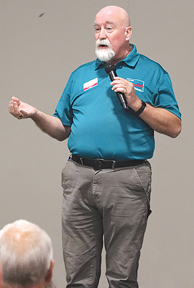
“We’ve been a little bit ahead of the game, but we still don’t know what a data center does; there are so many different ones,” Divide County Commissioner Chico Eriksmoen said at the open house. “And whether or not it would be beneficial for our community -- I don’t think we have those answers today.”
State Sen. Mark Enget, R-Powers Lake, organized the forum and said he was pleased with the turnout.
“I think we got a good showing,” Enget said. “I honestly didn’t know what to expect.”
The open house took an informal approach, with tables set up with representatives from electric utilities, state agencies and county commissions ready to answer questions.
Tia Johnson, a resident of rural Crosby, said she would have preferred a more “open discussion” with multiple speakers getting up to give presentations and answering questions.
“It still comes off as gatekeeping, where the information isn’t going to be available readily, and the same information is not going to be relayed to everyone,” Johnson said. “But I don’t want to discredit the information is here, and where else would I be able to talk to people from Bismarck or Fargo, our commissioners and our district representative?”
At one table, personnel from Basin Electric Power Cooperative, Mountrail-Williams Electric Cooperative and Montana-Dakota Utilities answered questions about data centers’ electric consumption.
In addition, representatives from the state Environmental Quality, Water Resources and Commerce departments answered questions about economic impacts, taxes, jobs, impacts on the environment and other questions relating to the changes a community might see as a result of a data center being built nearby.
“I thought it was going to be an open discussion about, ‘Do we even want data centers?’” Johnson said.
However, Johnson said she left feeling relieved that local residents have some control over whether data centers enter their community.
“National policy can say a lot of stuff, but it is the people who implement it,” Johnson said.
Also in attendance at the informational meeting was Ellendale Mayor Don Flaherty, who was invited by Enget to speak about his personal experience with the data center near that city.
Flaherty answered questions about how the data center impacted his community, noting the largest change was the city’s sales tax revenue after the facility was annexed and became subject to Ellendale’s 2% tax.
“Once they became annexed in, then their construction materials became subject to city sales tax,” Flaherty said. “We were shocked when we ended up, at the end of 2025, with $1.1 million of sales tax revenue.”
He added the city has already generated $4.5 million in excess revenue through the first eight months of this year, and plans to use it to renovate the city senior center and create a walking trail, among other projects.
Despite Flaherty’s generally positive impression of the data center in Ellendale, Enget emphasized that the meeting was not intended to take sides one way or another.
“Our goal today is not to manufacture agreement,” Enget said, “but rather our goal is to improve understanding.”
Regional leaders are already comparing the rapid rise of data centers to past oil booms, noting how there were both positive and negative effects of the sudden growth the county experienced.
One such negative, Divide County Commissioner Isaac Jacobs said, was supposedly “reclaimed” land where oil wells were removed but not properly cleaned up.
Some counties have already implemented strict zoning rules for this. Divide County’s ordinance has a clause about “abandoning or ceasing” that provides specific instruction about decommissioning data centers in the county.
Local officials are also evaluating regulations for the design of the buildings, setbacks from residential areas, water usage, noise, security and accessory structures that must fit county zoning requirements.
Divide County commissioners said they would only consider data centers if it was clear the residents wanted them -- no approval from residents, no data centers.
“There isn’t a moratorium right now,” Jacobs said, “but if we were approached by a company and we wanted to put one up, we could.”
“It’s going to change the dynamic of our community ... and it may not be positive,” Eriksmoen said. “There is money there, but is it money worth chasing?”