
A Nasty Weed In Our Town
By Julie Woodbury
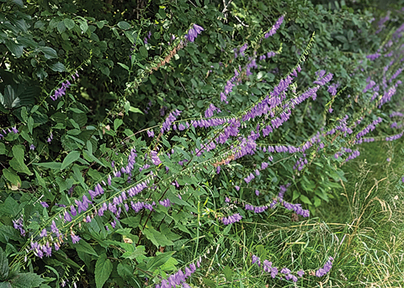
Did you know there’s a nasty weed taking over our town? The Mountrail County Garden Club learned about the invasive weed Creeping Bellflower, Campanula rapunculoides at their December 16th meeting. According to Janinne Paulson, MCGC VP of and presenter to the Garden Club, Creeping Bellflower has been in her yard since at least 1990 and continues to spread aggressively. The plant originated in Europe and Asia and was brought to the United States as an imported ornamental.
Janinne says the weed, while pretty, takes over the entire space and chokes out desired plants. It spreads by both rhizomes and seeds, and even a thin one-inch piece of root can sprout new plants. While both the rhizomes and leaves are edible, they are difficult to remove. Janinne has heard stories of people digging down over two feet. Some of them go so far as to remove all the soil to two feet of depth or more and replace it. Janinne says digging up perennials and removing CBF rhizomes can help reduce the spread of the weed. Janinne follows the Facebook group Creeping Bellflower Battles.
Creeping Bellflower has pretty little bell-shaped flowers which are similar to both Harebell - Campanula rotundifolia, and American Bellflower (also called Tall Bellflower) - Campanula americana. However, these two plants are both native to North America, are not spread by rhizomes, and are neither aggressive nor invasive. Homeowners wanting the look of Creeping Bellflower should choose these native plants instead.
Janinne says the first step in controlling this and other invasive plants is awareness and identification. The new leaves look quite a bit different than the mature plant, with the distinctive purple flower spike topping the two- to three-foot tall plant. Once identified, one can try to remove plants and roots by hand, but because of the aggressive rhizomes, diligence is required. The plant is not well controlled by glyphosate (Roundup) or other common herbicides. The herbicide Triclopyr is effective, especially if applied in fall, but there are risks of damage to other plants because of that herbicide’s residual nature. If herbicides are used, label directions must always be followed. Smothering of Creeping Bell Flower (CBF) is not usually effective either.
Janinne has advice for homeowners: “Related to our increase of awareness of pollinators, it’s important to know that its spread reduces the availability of plants that are more beneficial for our pollinators. Though eradication is extremely difficult due to the spread by rhizomes, at minimum when CBF is seen and is in its flowering stage, the blooms should be removed so the plant doesn’t have a chance to go to seed and further spread by that means, as just one plant can produce up to 15,000 seeds. While not classified as a noxious weed, this plant is considered invasive throughout the upper Midwest and central Canada and there are currently strong campaigns about eradication underway in Minnesota, Wisconsin, Alberta, Manitoba and Saskatchewan.”
The State of North Dakota maintains a list of Noxious weeds, and landowners are required by law to control their growth and spread. Homeowners must learn to identify these weeds, which are very common in town. The most common include Canada Thistle - Cirsium arvense, Field Bindweed aka Creeping Jenny - Convolvulus arvensis, Spotted Knapweed - Centaurea stoebe, and Purple Loosestrife - Lythrumsalicaria, among others. This reporter has seen a great deal of Field Bindweed in Stanley, and both Field Bindweed and Spotted Knapweed in Ross.
Information about Noxious Weeds is available in many places. Mountrail County Master Gardeners can help with identification. Mountrail County Weed Board can help with both identification and control. The Noxious and Troublesome Weeds and recommended control measures can be found at:
https://www.ndsu.edu/agriculture/extension/publications/identification-and-control-invasive-and-troublesome-weeds-north-dakota
Photos of Creeping Bellflowerand additional facts can be found at:
https://extension.umn.edu/weeds/creeping-bellflower
We encourage all residents to learn more about these weeds, and to help control the spread of them.