
Staff Participates In Response Training
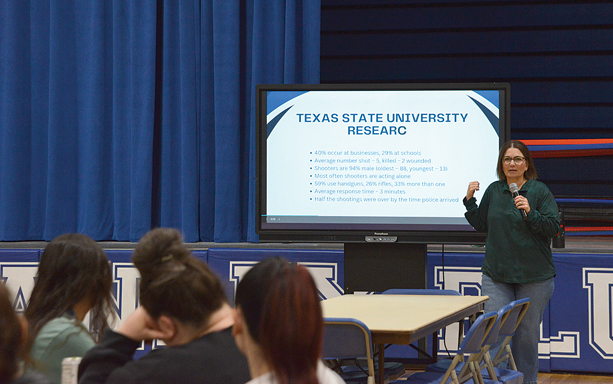
On Friday, Oct. 16, staff members from Stanley Public School District participated in active threat response training designed to strengthen the district’s emergency preparedness and school safety procedures.
The training took place at both Stanley Elementary School and Stanley High School, where staff members worked through multiple scenarios designed to simulate potential emergency situations. These exercises allowed staff to practice responding to threats using the Run, Hide, Fight approach. This approach emphasizes making informed decisions based on the circumstances of an emergency, including evacuating when safe, finding a secure location when evacuation is not possible, and taking action to protect oneself as a last resort.
The day started with all staff in the high school gym as High School Principal Alecia Pulver and Superintendent Tim Holte went through some of the information staff would be considering for the simulations later. As they started, they talked about the school shooting the day before in Oregon. This was the 52nd school shooting this year.
Columbine was a learning experience for everyone. At that time, law enforcement was told to set up a perimeter and wait for SWAT to arrive. Since then, changes have come on all sides as they look to respond effectively and safely for everyone in the building.
Pulver said that the strategies they would talk about would provide options for staff as they wait for help to arrive. Although in Stanley we have local police, the sheriff’s office and the highway patrol, it might still be awhile before they are able to clear the building and get everyone to safety.
That includes use of the school’s emergency app and the run, hide or fight principles. The goal with training is to give staff a way to create a plan of action on what to do based on where they are and what is happening.
It comes back to the ALICE theory. A is for alert, which will come from what they hear as well as the emergency app. L is for lockdown. If you can do that quickly, it gives you time to assess what is happening and make the room more difficult to enter. I is for inform. That comes from the cameras, the schools’ public address systems and sharing information with the app. C is counter. This is not necessarily fighting, but taking control back. This is where they will make a choice to do whatever they have to do to save lives and take control. E is evacuate. If they find they are able, they can get out and go to the schools’ reunification sights. Staff will observe, orient, decide and act. This training is not only valuable in school, but also anywhere they may be.
Stanley School Resource Officer Briana Dazell also spoke on behalf of the Stanley Police Department about their role in this training. She said that this will give staff a chance to see how they will respond, what to expect and what to do. She also noted that agencies will respond from around the area in the event of a real situation and she said to let those agencies take care of the problem.
The Stanley Police Department, Mountrail County Sheriff’s Office, and Stanley Ambulance Service participated in the training alongside school personnel. Their involvement was an important component of the exercises, providing an opportunity for school staff and local emergency responders to work together in a realistic training environment. This type of collaboration helps strengthen communication, coordination, and familiarity between the agencies that would respond in the event of an actual emergency.
The district recognizes that preparation, communication, and cooperation with local emergency responders are essential components of maintaining a safe learning environment. Conducting exercises in both school buildings provided staff with opportunities to practice their responses in their own work environments, evaluate existing procedures, and identify areas for continued improvement.
The training also reinforced the importance of the ongoing partnership between Stanley Public School District and local emergency response agencies. By working together before an emergency occurs, school personnel and first responders can develop a better understanding of their respective roles and responsibilities, helping create a more coordinated response should a serious incident ever occur.