
Farm And Ranch Day Held
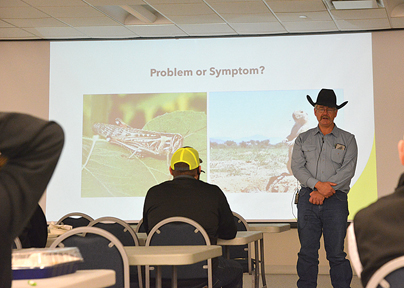
The Mountrail County Ag Improvement Association hosted their Annual Farm and Ranch Day program on Wednesday, Feb. 11 at the Mountrail County South Complex.
The day’s speakers kicked off with keynote speaker Alex Frasier, who farms near Faulkton, SD. Alex also is an agronomist with Independent Ag, cover crop coach for Farmers for Soil Health, and works in corn research and product development. He is a fourth generation producer and partners with his dad, Jayme, at Frasier Farms in South Dakota. Frasier raises no-till soybeans, corn and spring wheat, along with certain species of cover crops, on their regenerative row crop farm. Next year, they plan to switch out the spring wheat for another small grain, such as cereal oats or rye. Having diverse crops growing together is part of their soil health plan. He farms 900 acres of corn, beans, and wheat. His passion is soil and blending conventional and regenerative practices to make it doable on the average farm.
He talked about the farm struggles he had from 2014 to 2016 which forced him into ag retail. At 22, he was managing a location but he did not like what he saw. He decided he wanted to start work as a cover crop coach, switching to regenerative processes without sacrificing yield and profits.
He says what they do is unique using intercropping with oats, flax and cereal rye with their soybeans. They use those plants as part of their weed control in their system. They continue to experiment with those cover crop plants and over time they see benefits to the soil health. They look to increase their biological count with nutrients that feed that soybean crop. Because what they use are cool and warm season plants, they do not compete at the same level.
By combining the way they grow and establish, they are able to also take care of any chemical sprayings while working to avoid system herbicides that are hard on the soil and plant.
They have also found several non-yield observations in their soybean crops. They have found more nodulation and the first pod is higher on the plant. They have bigger, stronger roots and because of the cover crops they have lower soil temperatures. They have seen Kochia suppression. They can also see the soil structural changes along with more efficient water use.
He also stresses the value of soil testing each year. Farmers are able to see what is happening with the intercropping and the way nutrients increase. That helps to control the inputs by spending in the right place at the right time. It shows that all the things they are doing make the difference.
Lessons learned include rotation is a big factor. While they are always trying to push their planting dates earlier, they also note that the biggest mistake is when they plant in weather conditions that are too wet. Using the right testing methods are key as they are always trying new things to make better progress.
Moving forward, they are looking to add to their mix to satisfy the biome. They choose diversity over density. That included adding some cover crops to their wheat intercropping and then spraying it out after it shares its biology.
The goals are to be more profitable, control what you can, and compound the positives. He says that if you believe in the why, you will figure out the how.
He shared resource materials including YouTube videos Carbononomics by Keith Burns, Phosphorous Paradox by Christine Jones, Nitrogen Solution by Christine Jones and Potassium Paradox by Regenerative Ag Podcast. He also recommended the book A Soil Owner’s Manual by Jon Stika.
Dessert Contest winners were announced following the first speaker.
In the youth division, first place went to Adela Heberlie with her valentine’s cake; second place to Rio and River DeTienne for grandma’s favorite cream puffs; third place to Adela Heberlie with her country kitchen Oreo cake; fourth place to Molly Hamilton for her chocolate covered strawberry brownies; fifth place to Ryley Johnson for cinnamon roll cookies; and sixth place to Omni Roise for mocha crinkle cookies.
In the adult division, first place went to Kristina Johnson for her chocolate chip cookie dough cheesecake; second place to Bekka Enge for her berry Chantilly cake; third place to Jenna Waldock for her snickers cake; fourth place to Joyce Waldock for her juneberry pie; fifth place to Joyce Waldock for her white chocolate raspberry dream; and sixth place to Kristina Johnson for her banana pudding cookies.
Prizes were awarded to the top places in the youth and adult divisions, along with additional cash prizes for first through third place in each division. The desserts were then auctioned off to raise funds for the Ag Improvement scholarships. This year’s auction raised $3,125.00. Following the dessert auction, lunch was served by Bravera Bank of Stanley.
Following lunch was the second keynote speaker, Bart Carmichael from Faith, SD, and the Wedge Tent Ranch. When Bart Carmichael moved to the family ranch two days after graduating high school, his grandfather ran cattle through four seasonal pastures. Bart and his wife Shannon bought Wedge Tent Ranch from his grandfather in 1996 and, with the help of their four kids, have managed to change the ranch over the years for the better.
When he began his movement toward a low-input grazing system, Bart attended a South Dakota Grassland Coalition sponsored event where he met Terri Gompert and came away with new knowledge to bring back to his ranch. Bart sought out wisdom from other grazing management figures like Wayne Berry and Jim Gerrish. Bart stayed involved with the Coalition and has served on the board of directors for the past three years because he believes in the value of healthy grasslands and the role education plays in holding onto them. Bart puts on many workshops and schools throughout the Midwest.
He is the co-founder of Principled Land Managers, helping landowners and producers strengthen both the ecological and economic health of their operations while demonstrating how thoughtful stewardship can restore productivity, biodiversity and beauty to the prairie.
He started by having a volunteer put together a puzzle that showed the ranch area. Then he added a new piece and asked them to figure out where to put it. That often changes the picture for a producer as they shuffle what they have to make it work.
He talked about the ecosystem of living things, living and working together and the relationship they have to each other.
He talked about the amount of grasslands lost in the last fifteen years along with the impacts grasslands face. There is a decrease in the diversity of plant communities, increased edge habitat, decrease of invertebrates and a decrease in rangeland health.
Management of the ecosystem processes includes the energy cycle, water cycle and mineral cycle. The more the environment cycles, the more it builds.
Management of the diversity of species is as important to the future as breathing is to the present. Management influences the outcome, which is why they try to do something different every time. He says they pattern after nature’s model. You do not have to do what grandpa did, but do not forget what grandpa knew.
He says they look at purpose beyond profit. While it is important to be profitable, it is important to find your “why”. His why is his family and how to get them involved in the operation.
He stresses using soil health principles with the grazing principles. That includes rest and managed alternate timing, as well as noting the effects of wildlife and livestock when it comes to those strategies and biodiversity. The above ground diversity creates the below ground diversity.
They watch for indicators of change including wildlife, plants, insects and production. He says that it is important to note that things may not be just a problem, but also a symptom.
That includes looking at pest problems. When killing pests, you may also kill the beneficial species. Insects keep the cycle going.
Restorations options for grasslands include rotation, recovery and rest. That includes some intercropping after grazing it down to increase the restoration process. He spoke about the value of forbs and flowers in rangeland.
He says the first step is management. Have a plan and implement it. Observe and adjust as needed, learning as you go.
As for soil health principles, he pointed to the importance of keeping it covered, optimize and alter disturbances, manage for living roots, enhance diversity, increase stock density and reduce length of time, as well as incorporating livestock.
He urges producers to avoid overgrazing and providing that armor of keeping ground covered to protect from extreme weather.
Rest your land to let it recover. His process means that the land has that chance to recover, rest and rejuvenate the soil. It is important not to repeat what you did last year so everything has rotation. He encourages ranchers to manage for living roots all year, match stocking rate to carrying capacity. He says the land will tell you what those numbers should be.
Increasing stock density is better for soil health, but it does have a limit. He points to short grazing periods in any specific spot, taking and leaving as much as you need as fast as you can.
The day concluded with the Ag Improvement annual meeting and the commodity elections. This year, producers were set to elect representatives to the corn, barley, and dry pea and lentil commodity councils.